BASIC ELECTRICAL and ELECTRONICS ENGINEERING FORMULAS
EE REFERENCE, THEOREMS, CIRCUIT DESIGN AND ANALYSIS, ELECTRIC CALCULATIONS
<--------------------------------------------------------------------------------------------------------------------------->
Let's start with quick definitions. Electronics involves the design and analysis of electronic circuits. Originally, this subject was referred to as radio engineering. "Circuit" is a collection of components through which electrical current can flow or which use electromagnetic fields in their operation.
Basic circuit design and analysis is based primarily on two Kirchoff's laws, Ohm's law modified for AC circuits, and power relationships (see below). There are also a number of network theorems and methods (such as Thevenin, Norton, Superposition, Y-Delta transform) that are actually consequences of these three laws.
In order to simplify calculations in AC circuits, sinusoidal voltages and currents are usually represented as complex-valued functions called phasors. With phasors we need to solve algebraic equations instead of differential equations (see below). In general, practical circuit design and analysis requires an understanding of semiconductor devices, integrated circuits, magnetics, DSP, and feedback control.
Here you will find electricity and magnetism reference, basic electrical engineering formulas, calculators, and other related information.
Also see:
Electrical engineering reference: electric network laws and theorems;
Electronic parts datasheet and cross-reference;
The guide to accredited online schools, distance learning programs and courses.
Basic circuit design and analysis is based primarily on two Kirchoff's laws, Ohm's law modified for AC circuits, and power relationships (see below). There are also a number of network theorems and methods (such as Thevenin, Norton, Superposition, Y-Delta transform) that are actually consequences of these three laws.
In order to simplify calculations in AC circuits, sinusoidal voltages and currents are usually represented as complex-valued functions called phasors. With phasors we need to solve algebraic equations instead of differential equations (see below). In general, practical circuit design and analysis requires an understanding of semiconductor devices, integrated circuits, magnetics, DSP, and feedback control.
Here you will find electricity and magnetism reference, basic electrical engineering formulas, calculators, and other related information.
Also see:
Electrical engineering reference: electric network laws and theorems;
Electronic parts datasheet and cross-reference;
The guide to accredited online schools, distance learning programs and courses.
FORMULAS FOR THE BASIC CIRCUIT COMPONENTS |
|||||
| CIRCUIT ELEMENT |
IMPEDANCE | VOLT-AMP EQUATIONS | ENERGY (dissipated on R or stored in L, C) |
||
| absolute value | complex form |
instantaneous values |
RMS values for sinusoidal signals |
||
| RESISTANCE | R | R | v=i×R | Vrms=Irms×R | E=Irms2R×t |
| INDUCTANCE | 2πfL |
jωL | v=L×di/dt | Vrms=Irms×2πfL | E=Li2/2 |
| CAPACITANCE | 1/(2πfC) | 1/jωC | i=C×dv/dt | Vrms=Irms/(2πfC) | E=Cv2/2 |
|
Notes: R- resistance in ohms, L- inductance in henrys, C- capacitance in farads, f - frequency in hertz, t- time in seconds, π≈3.14159; ω=2πf - angular frequency; j - imaginary unit ( j2=-1 ) Euler's formula: ejx=cosx+jsinx |
|||||
|
|
| |||||||||||||||||||||||||||||||||


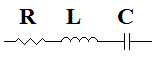
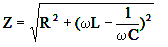

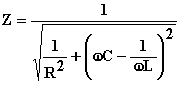
TRANSISTORS AND DIODES: THE BASICS
The properties of semiconductor devices are studied in college courses. The introduction to the circuits including operation of diodes and transistors and basic formulas can be found in various textbooks or handbooks, such as The Art of Electronics. Below are just some highlights.
The I-V characteristic of a diode is approximated by the Shockley equation:
I=Is×(enVd/Vt-1),
where Is - the reverse bias saturation current (~10−15 to 10−12 A for Silicon); Vd - forward voltage drop in volts; Vt - the thermal voltage (~0.026V at room temperature), n - the "ideality factor" (from 1 to 2). At a fixed current I, voltage drop Vd changes by about -2 mV/oC.
In a bipolar transistor collector current Ic in linear mode is related to the base-emitter voltage by the same Shockley (also called Ebers-Moll) equation, except for n=1. The collector current relates to the base current IB by Ic=IB×h21, where h21 - static current gain (typically 20-1000). However, Ic can't exceed Vin/|Z|, where Vin- the supply voltage, Z- net impedance in the external collector circuit. When Ic reaches the above limit, the transistor is saturated.
MOSFET behavior varies with the gate voltage Vg. When Vg<Vth, where Vth - gate threshold voltage, the MOSFET is in OFF state with drain current Id≈0. When Vg>Vth and the external load is such that Vd>Vg-Vth, the MOSFET is in an active region, in which Id is proportional to the (Vg-Vth)2 and practically does not depend on the Vd. Once Id reaches certain limit determined by an external circuit, MOSFET start acting as a nearly constant resistance. In this mode Vds≈Id×Rdson, where Rdson - the ON-state channel's resistance specified in data sheets as a function primarily of temperature and gate voltage. Power MOSFETs are usually used as switching devices which operate in either ON or OFF state.
ELECTRONIC COMPONENT SEARCH: DATASHEET, ONLINE CATALOGS, AND APP NOTES
|
ELECTRICITY AND MAGNETISM
Classical electromagnetism reference for students and engineers: Maxwell's equations, electrical formulas, theorems, tutorials |
ELECTRONICS REFERENCE
An introduction to basic electronic circuit design and analysisElectronic components - cross reference and parts' search My picks of books on electronics and circuit design |
ELECTRIC CALCULATION PROGRAMS
A collection of electrical engineering software and other toolsOnline scientific calculator Metric to U.S. calculator online |