YOUR GUIDE TO PORTABLE ELECTRIC GENERATORS
OVERVIEW, COMPARISON, SELECTION
THE BASICS.
Okay, so you want to choose an emergency generator, and don't know where to start. You came to the right place. I'll explain you how it works, what types are available, how to choose the right one and how to connect it. Generally, there are different types of backup power devices depending on their operation and the source of energy. Here we'll talk about portable generator (or genset).WHAT IS IT?
Technically speaking, portable generator is an electro-mechanical device designed to temporarily provide power by burning supplied fossil-based fuels. Again technically, it is actually a set containing an engine and a generator mounted together. Therefore it is often called genset. As the name implies, portable gensets are for stand alone (non-hardwired) applications. They are called "portable" because they can be moved from place to place. You can use them to energize a few appliances via extension cords, although high-end models if properly connected can power an entire home. Besides home use, portable generators are utilized on construction sites and basically everywhere where the grid is not available.CHOOSING THE FUEL TYPE.
People tend to think about a generator as if it is a kind of generic device. In reality, it comes in various types, which we are going to discuss below. Depending on the design, genset's engine can run on gasoline, diesel, propane, or natural gas. Of course, each design has its advantages and disadvantages. So, let's go over the pros and cons. Most small models are powered by gasoline drawn from the on-board tank- this is what makes these generators truly portable. However, this also results in a short run time- typically it is less than twelve hours per tankful. If you run such a device continuously at rated load you will need to shut it down several times a day for refueling. Note that you can't do refueling while the genset is running- it is absolutely unsafe! There are also more expensive models on the market that can be hooked up to an external fuel source (natural gas, LPG or diesel) and supply electricity for longer periods of time. They can be even used as home generators. However, remember, these devices still have to be frequently shut down for oil changes.My Home Generator eBook - Complete Step-By-Step Guide On Selecting, Sizing and Connecting Gensets
Diesel generators are the most efficient, a bit more quite, and have the longest engine's life. Not surprisingly they are more expensive- a mid-power model may cost a few thousand dollars. Other advantages of diesel are it's the least flammable fuel source and it has longer shelf line. Diesel likewise may not be available during a blackout.
Propane (LPG) is my favorite choice. It can be easily stored in large tanks, has practically unlimited shelf life, and besides natural gas, is the only fuel that may be available during major power interruptions. Among all types, an LPG-powered genset will more likely start in extremely cold weather (unless of course the pressure in the tank runs too law). It is a good choice for portable emergency power. You may get a decent LPG genset for around $1000.
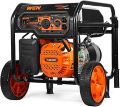
Finally, there are multi-fuel devices (usually bi-fuel). They offer more options when one type of fuel is not available. Usually a simple adjustment is needed to switch from one type of fuel to another. Although multi-fuel models are quite pricey, they still cost less than standby systems with the same wattage, and you don't have to pay for the installation. In my view, a bi-fuel device running on propane and gasoline is the best choice for emergency power because you will not stuck with just one fuel source.
FEATURES and OPTIONS.
When choosing a genset, aside from rated wattage, type and price, there is a number of other features and accessories to consider. Most gensets will sound like a lawn mower. So-called quiet models normally cost more and are not available in high power range. And they are still noisy, although to a lesser degree. By the way, it would be a good idea to check in advance if there are any noise restrictions in your neighborhood. Besides noise level, look for the following useful features: voltage regulator (AVR), electric start (in addition to manual recoil), OHV engine, twist-lock receptacles, and oil gauge. Most models include all of the above though. If you plan to use your device without a transfer switch, look for a built-in GFCI for additional safety. Since a typical model may weight several hundreds pounds, you definitely want to get a wheel kit- devices with wheels can be moved around by one person. If you need a clean sinusoidal voltage for sensitive electronics, consider inverter-generators. Unfortunately they are priced typically twice as high as regular ones.Finally, for a peace of mind it is preferable to have a part that is listed with the Underwriter's Laboratory (UL) or FM, or a respective safety agency in your country. As for wattage, here is a lesser-known detail: the portables are often listed and advertised by their short-term starting watts rather than by continuous power. For more information on specific models see our portable gensets ratings page, which provides a comparison chart with main features and recommendations.

Electrical outlets provided by a typical mid-power portable genset (ETQ TG32P12): 240/120V L14-30R, 120V L5-30R, and 5-20R duplex with GFCI.
HOW TO CONNECT.
This is a very important topic. The most common method of hooking up your AC loads is by using extension cords. The genset's control panel has several 120VAC outlets. So, you just plug regular 3-wire cables into these outlets and run them through open doors or windows to the appliances you want to power. Be sure to use heavy duty outdoor-rated cords. The required wire size depends on its length and the rated load current. As a rule of thumb, #12 AWG cord is sufficient for currents up to 20 amps. Models rated above 5 kW usually also provide a 120/240 output via their 30 or 50-amp 4-hole receptacle. With such models, instead of running individual cables, you may buy a 4-wire extension cord. It plugs into the high-current locking 120/240VAC receptacle of your generating set and provides several outlets on the other end. Note that as a rule, a single outlet will not provide full generator's power. See my eBook for connection diagrams and pinouts of various connectors. The cords method perhaps is your only option if you are looking for a quick solution. However your lights and everything else that is directly connected to your house wiring will not be powered. You will need to figure out how to disconnect them one by one from the building wiring and then connect to the cords. You would have to go through all these troubles every time you need to use a generator. This is something many people don't realize beforehand. A more convenient and safe method is to hook up your power source to the house via a transfer system. It connects your house either to the genset or to the grid and prevents so-called backfeeding. Backfeeding can hurt anyone working on the power line or coming in contact with a wire and is illegal. A transfer switch also protects your device from damage if service restores while it is running. Once you wired the switch, all you need to do is roll out your genset from a storage and connect its high-current twist-lock to the inlet box via a single cable. You can either buy such a ready-to-use generator cord or you can get a proper plug and a socket and build it by yourself. See the above pinout diagram of the outlet for the wiring of a single-phase 125/250V 30A 4-prong plug NEMA L14-30P. Since a single outlet is usually rated below generator's ampacity, you can still run some extension cords for the balance of wattage. The hook-up via a transfer switch is safer and gives you more flexibility. However, obviously, it increases your cost and requires a professional installation. Also note, most guides and reviews won't tell you that a genset with GFCI will not work with a regular changeover panel. You may need to get a special 3-pole transfer device or otherwise disable the GFCI, which is not quite safe and is not recommended. For more details see a chapter of my book on GFCI issue.
 PORTABLE GENERATORS SAFETY.
Your owner's manual of course will include the recommended safety rules. However you may want to know certain basic less obvious things in advance because they may affect your choice.- Just like all engine containing devices, electric gensets should always be used OUTDOORS. You should locate them at least 15 feet away from the house to avoid carbon monoxide and fumes build up.
- A genset should never be connected directly into a wall outlet or your house unless it is isolated from the service lines.
- Most portable generators need to be protected from rain and snow.
Below you will find additional resources you may want to read to learn more about portable generator and to choose the right one for your application.
REVIEWS, SELECTION GUIDES, BASIC SAFETY TIPS
A guide to commercial and residential portable generatorsConsumer Reports review and buying guide
OSHA safety fact sheet
Understanding portable gensets features and terminology